
I remember the first time I chased down a stuck SOL transfer. Panic hit fast. Wallet said “pending,” the DEX looked fine, and I had no idea where the money was. That hit me: fast networks need fast, clear tools. Solscan filled that hole for me. Quick, sometimes raw, and oddly satisfying when the data lines up. I’m biased — I’ve used several explorers — but Solscan keeps returning as my go-to for Solana analytics and transaction forensics.
Short version: Solscan gives you transaction details, token holder lists, program calls, and cluster stats in ways that are scrollable and searchable. It doesn’t hide complexity, which is good—because blockchains are messy. This article walks through practical ways to use the explorer, what to watch for, and how to avoid common mistakes when analyzing activity on Solana.
Getting oriented — what Solscan shows you (and what it doesn’t)
On the surface, explorers all look alike: input an address, get a feed. But Solscan leans into Solana-specific details. You get a breakdown of transaction instructions, inner instructions (important on Solana), token transfers, and program logs. That matters because, unlike EVM chains where a single tx often equals one action, Solana transactions are instruction-heavy—multiple instructions in one shot. Solscan surfaces those cleanly.
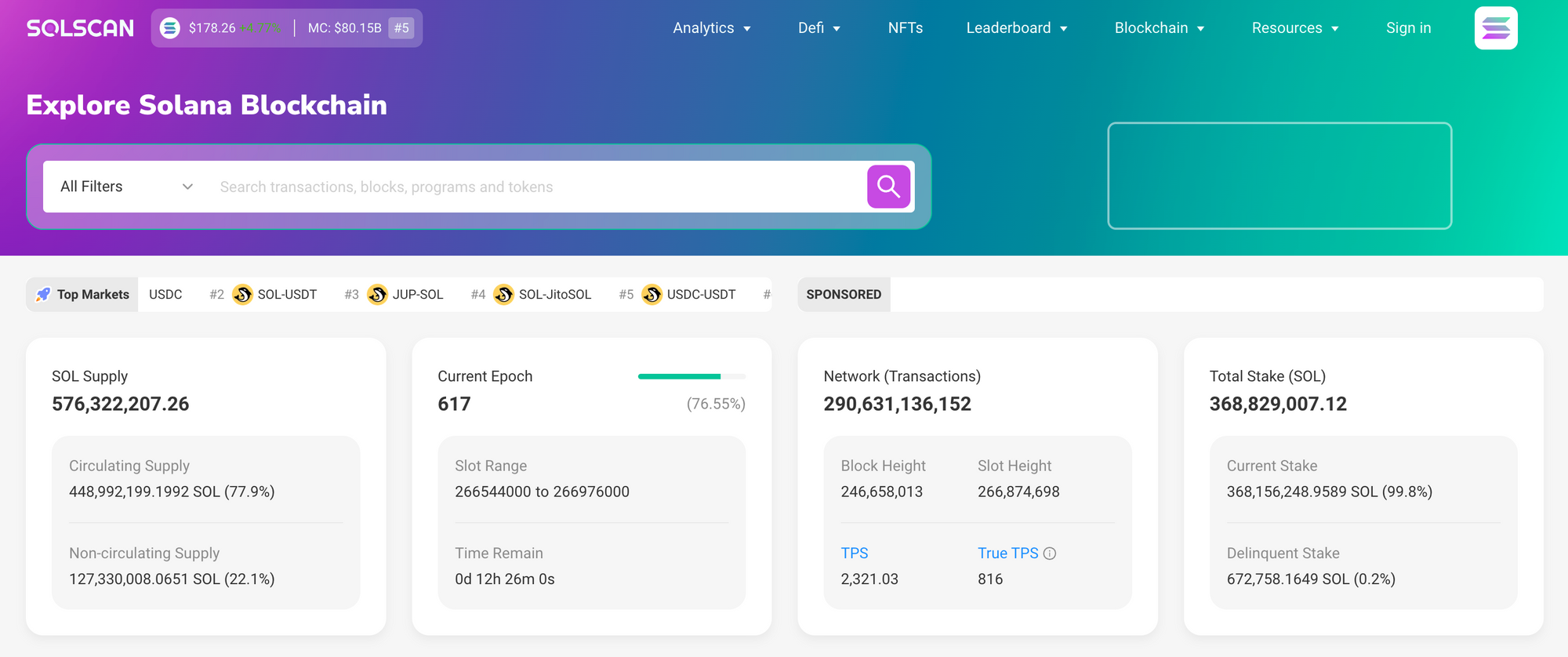
Check out the solscan explorer official site if you want to follow along. Use the search bar for addresses, tx hashes, tokens, or programs. You’ll quickly spot the differences between a simple SOL transfer and a composite transaction interacting with Serum, a Metaplex NFT mint, or a staking program.
Here’s a practical checklist when you land on a transaction page:
- Look at the “Status” — failed vs confirmed vs finalized. Finalized is the one you can bank on.
- Read the instruction list. Which programs were called and in what order?
- Open the inner instructions and logs. They often reveal why a tx failed or why a token balance didn’t move as expected.
- Check fee payer and rent-exempt balances. Sometimes a tx fails because a program account needs more lamports.
Deep dives: tokens, NFTs, holders, and on-chain analytics
Solscan’s token pages are underrated. Want to see distribution? The holder list will show large holders and what percent they own. That’s crucial when evaluating token risk—if three wallets hold 80% of supply, that’s centralization risk in plain sight.
For NFTs, Solscan displays metadata and creator addresses. That helps when verifying authenticity. Fraudsters sometimes reroute royalties or mislabel collections; seeing the mint authority and verified creators helps separate legit projects from knock-offs.
Also, the program analytics page is useful for devs and auditors. You can observe invocation counts, success/failure rates, and recent transaction examples. For DeFi teams, that’s a quick litmus test to spot spikes in interactions (maybe an airdrop or a bot run) that you might otherwise miss.
Interpreting timeseries and charts — what to trust
Solana’s high throughput means “blocks” feel less meaningful than on slower chains. Instead, focus on transaction volume and lamports per second patterns. Spikes often indicate batch operations—airdrops, indexer syncs, or bot activity. Don’t immediately read intent into volume changes; correlate timestamps with project announcements, Discord posts, or GitHub merges.
Pro tip: export CSVs of holder lists or transaction histories when doing due diligence. Manual spot checks are good, but a quick aggregation can expose patterns—like repeated transfers between a small set of wallets that look like wash trading.
Practical troubleshooting scenarios
Scenario 1: Your swap fails with “Program failed to complete” — open the logs. Often you’ll see insufficient liquidity or a constraint violation. The logs tell you which instruction failed and sometimes why.
Scenario 2: Token balances don’t match after a transfer. Check for associated token accounts. On Solana, tokens reside in SPL accounts tied to wallet addresses. If a destination doesn’t have an ATA, the transfer can go to a delegated account or fail silently—so confirm the ATA exists.
Scenario 3: You’re tracking a suspicious wallet. Use the “Related Addresses” and program call history. Watch for patterns: repeated calls to the same staking contract or repeated small transfers to a mixer-style address. Correlation is not proof, but it helps build context.
Advanced: combining Solscan with other tools
Solscan is strong on UI and quick lookups. When you need programmatic analysis, export data or pair it with indexers (The Graph-like services for Solana) and on-chain analytics platforms. I often use Solscan to identify interesting txs, then pull raw logs via RPC or an indexer for batch analysis. It’s a two-step workflow: human-first discovery, then machine-scale verification.
Also, watch validator and cluster pages. Network congestion, skip rates, or leader scheduling changes can explain delayed confirmations. Solscan integrates some of these metrics, which is handy when diagnosing why a normally quick tx isn’t finalizing.
FAQ
How do I confirm a transaction is irreversible?
Look for “Finalized” status. Solana has multiple confirmation stages—processed, confirmed, finalized. Finalized means the cluster completed consensus on that slot and it’s stable. For most user needs, finalized is the safe marker.
Can I rely solely on Solscan for audits?
No. Solscan is excellent for inspection and quick forensics, but full audits need raw on-chain data pulled from RPC nodes, static code analysis, and testnets. Use Solscan as the readable interface, not the single source of truth for formal security audits.
Leave a Reply